PROFESSIONAL PROFILE
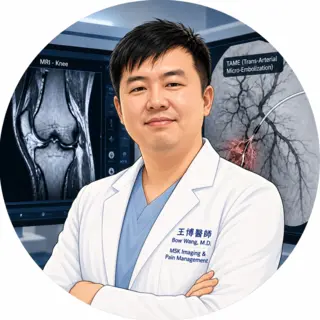
Bow Wang, M.D.
Musculoskeletal Radiologist · Interventional Radiologist · Pain Specialist
OUTPATIENT CLINIC UPDATE
Clinic currently suspended
Future outpatient clinic availability will be announced separately. Please follow this website or the Facebook page for the latest update.
View the latest Facebook update ↗
Professional overview
Dr. Bow Wang is Director of the Interventional Medicine Center and an attending physician in the Department of Medical Imaging at National Cheng Kung University Hospital. His clinical and academic work focuses on musculoskeletal imaging, vascular and nonvascular intervention, image-guided pain treatment, and transarterial microembolization for musculoskeletal pain.
Current Appointments
- Director, Interventional Medicine Center, National Cheng Kung University Hospital
- Attending Physician, Department of Medical Imaging, National Cheng Kung University Hospital
- Assistant Professor, College of Medicine, National Cheng Kung University
Education & Training
- Tainan First Senior High School
- Doctor of Medicine, National Cheng Kung University
- Residency, Department of Medical Imaging, National Cheng Kung University Hospital
- Advanced training in musculoskeletal imaging
Professional Roles & Credentials
- Deputy Convener, Musculoskeletal Imaging Subcommittee, Radiological Society of the Republic of China
- Training Instructor for Non-oncologic Vascular Embolization, Taiwan Society of Interventional Radiology ↗
- Deputy Chair for Embolization, Imaging Committee, Taiwan Society of Regional Anesthesia and Pain Medicine
- Committee Member, Neuromodulation Treatment Promotion and Training Committee, Taiwan Pain Society
- Certified physician for mechanical thrombectomy in acute ischemic stroke
Clinical Expertise
- Transarterial microembolization for chronic joint and tendon pain (TAME)
- Percutaneous epidural adhesiolysis (PEA)
- Regenerative injection and image-guided joint, tendon, peripheral nerve, and spine intervention
- Musculoskeletal imaging and vascular/nonvascular interventional radiology
RESEARCH IDENTITY
ORCID and verified public profiles
- ORCID iD
- 0000-0002-0551-2983 ↗
- Researcher name
- Bow Wang / 王博
- Research fields
- Musculoskeletal and interventional radiology
- Keywords
- TAME · Genicular artery embolization · Musculoskeletal intervention · Transarterial microembolization
SELECTED PUBLICATIONS
Research publications
Wang B, Kuan FC, Gean CY, et al. Comparison of therapeutic efficacy between arthroscopic capsular release and transarterial musculoskeletal embolization in patients with adhesive capsulitis of the shoulder. J Shoulder Elbow Surg. 2026;35(9):2225–2233.
DOI 10.1016/j.jse.2026.03.011 · PMID 41903674 ↗Sung K, Chen CH, Chen TR, Chen YC, Wang B. Genicular Artery Embolization to Treat Refractory Anterior Knee Pain Associated with Quadriceps and Patellar Tendinitis: Report of 2 Cases. J Vasc Interv Radiol. 2025;36(12):2042–2045.e2.
DOI 10.1016/j.jvir.2025.08.010 · PMID 40816351 ↗Huang ZR, Chen PY, Chiu NY, et al. Transarterial Embolization for Chronic Postsurgical or Posttraumatic Pain of Musculoskeletal Origin: Clinical Outcomes and Imaging Correlates. Life. 2025;15(8):1208.
DOI 10.3390/life15081208 · PMID 40868856 ↗Liang KW, Lin HY, Hsu KL, Wang B, et al. Clinical and Radiological Outcomes of Transarterial Embolization for Adhesive Capsulitis. Korean J Radiol. 2025;26:230–238.
DOI 10.3348/kjr.2024.0883 · PMID 39999964 ↗Pan CY, Liang KW, Chen TR, Wang B. Added value of pre-procedural magnetic resonance angiography in transarterial embolization for refractory musculoskeletal pain. Front Med. 2024;11:1471504.
DOI 10.3389/fmed.2024.1471504 · PMID 39568746 ↗Lin HY, Liang KW, Wang B, Lee CC. Challenges and complications and their management of transarterial microembolization for chronic musculoskeletal pain. Eur Radiol. 2024;34:3260–3270.
DOI 10.1007/s00330-023-10328-5 · PMID 37853172 ↗Wang B, Tai TW, Liang KW, et al. Short-Term Effects of Genicular Artery Embolization on Symptoms and Bone Marrow Abnormalities in Patients with Refractory Knee Osteoarthritis. J Vasc Interv Radiol. 2023;34:1126–1134.e2.
DOI 10.1016/j.jvir.2023.02.028 · PMID 36889435 ↗Chen TR, Chang CW, Tai TW, Wang B. Anterior Knee Pain Associated with Hoffa Disease Alleviated with Genicular Artery Embolization: A Case Study. J Vasc Interv Radiol. 2022;33:1123–1126.e4.
DOI 10.1016/j.jvir.2022.05.020 · PMID 35688296 ↗
For the complete and current publication record, please see the ORCID profile.
This profile and website are provided for professional, academic, and medical education purposes. They do not constitute individualized medical advice or confirmation that a particular procedure is appropriate for any individual.