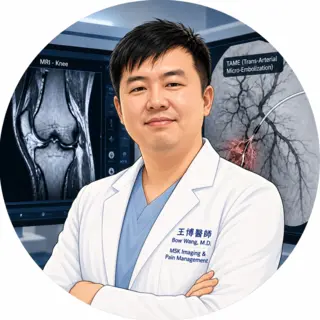
TAME & Musculoskeletal Embolization
A New Method for Pain Relief in Chronic Arthritis and Tendinitis: 【Transarterial Microembolization (TAME)】
Author: Wang Bo

A 76-year-old woman had been experiencing left knee pain for over two years. She had tried painkillers, patches, intra-articular injections, and rehabilitation, but the pain persisted.
Furthermore, the pain index (out of 10) has reached a high level of 9; pain begins after walking for only a short time, and without medication, the pain is so severe that it prevents sleep. After various treatments proved ineffective,
She went to National Cheng Kung University Hospital Orthopedics Clinic for treatment. After evaluation by the orthopedic physician, she was diagnosed with osteoarthritis of the knee and was then referred to the Interventional Clinic of the Department of Imaging Medicine for further interventional treatment.

Department of Medical Imaging, National Cheng Kung University HospitalBow Wang, M.D. stated that imaging evaluation revealed joint stenosis and osteophyte formation. Arterial angiography identified the proliferating capillary vessels, which were then embolized. After embolization, the patient's pain was reduced by half, with the pain index eventually dropping to a minimum. 2 points, pain significantly reduced when walking.
Many people, especially the elderly, experience aches and pains in their joints and tendons, which are unresponsive to heat therapy and stretching, leading to prolonged pain. They may have sought medical attention, undergone X-rays, and taken anti-inflammatory and pain-relieving medications.
They may have tried rehabilitation, shockwave therapy, and rest, but the pain persists, with little improvement. This may be a form of chronic inflammation and pain, which, while not life-threatening, is quite bothersome in daily life.
Bow Wang, M.D. says that this type of chronic pain is not easy to treat, mainly because the pain from this type of arthritis and tendinitis may be related to abnormal blood vessel growth.
Yuji Okuno, Japan Physicians have developed a technique for treating chronic, long-term inflammation:"Transarterial Embolization for Pain (TAME)",This technique aims to achieve pain relief. Currently, in addition to Japan, several physicians in South Korea and the United States are performing this technique and have published related research. Dr. Wang, after learning this technique, has already achieved good pain relief results in several treatment cases.
"Transarterial Embolization for Pain (TAME)" involves using a microcatheter under X-ray fluoroscopy and arterial angiography to select newly formed capillary-like vessels and administer embolizing medication to reduce pain nerve stimulation and alleviate local inflammation.
"Transarterial Embolization for Pain (TAME)" is mainly suitable for pain lasting more than 3 months, 5... Severe pain exceeding a certain threshold, including pain caused by osteoarthritis of the fingers, tennis elbow, golfer's elbow, frozen shoulder, rotator cuff tendinitis, osteoarthritis of the knee, Achilles tendinitis, and plantar fasciitis.Pain caused by these conditions. This pain management treatment can be considered when patients have tried various treatments including anti-inflammatory drugs, rehabilitation, shockwave therapy, patches, local steroid injections, hyaluronic acid, glucose solution, and PRP injections without significant improvement.
Bow Wang, M.D. stated that foreign studies have shown that transarterial embolization analgesia does not have the serious side effects of ischemia, necrosis, limb weakness, or sensory numbness that musculoskeletal causes. The most common side effects are temporary erythema at the treatment site and subcutaneous bruising at the puncture site in the groin, which usually improve and disappear within one month.
Bow Wang, M.D. points out that transarterial embolization (TAE) for pain relief requires evaluation by a professional physician. Its main effect is pain relief, but it cannot reverse tears in already degenerated joints and tendons. Therefore, if joint degeneration is too severe, surgery is still the primary treatment.
He also reminds people to pay attention to the maintenance of joints and tendons and to get adequate rest. Taking care of your joints and tendons is far better than treating or treating excessive wear and tear!
A new technology for treating joint pain: Transarterial embolization for pain relief ft. Bow Wang, M.D. [Is the joint okay?]
This page is for medical education and academic communication. It does not replace individual diagnosis or treatment advice.
Continue reading this category →